
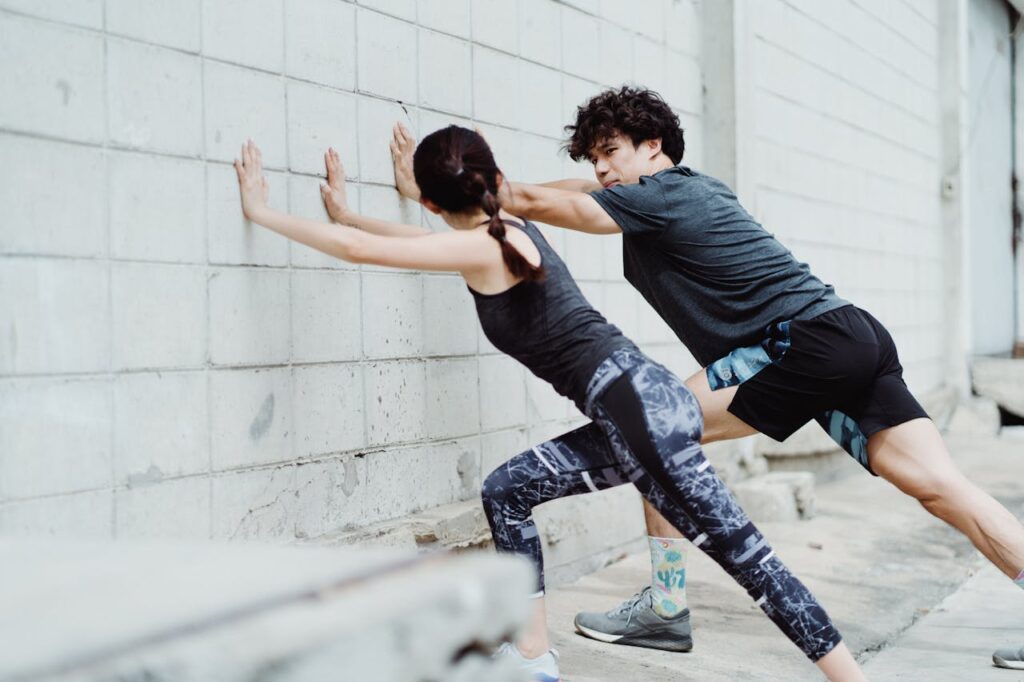
Wall angels are one of the most effective yet underutilized exercises for improving posture, shoulder mobility, and upper back strength. This simple movement, often called the “V to W” or “W to Y” stretch, can be performed anywhere with just a wall and a few minutes of your time. Whether you’re a desk worker struggling with forward head posture or an athlete looking to enhance shoulder stability, wall angels offer remarkable benefits for people of all fitness levels.
In this comprehensive guide, we’ll explore everything you need to know about wall angels, from the specific muscles they target to advanced variations that can take your posture correction routine to the next level.
What Are Wall Angels?
Wall angels are a postural exercise that involves standing against a wall and moving your arms in a controlled pattern that resembles making snow angels. The exercise gets its name from the angel-like arm movements performed while maintaining contact with a vertical surface.
The fundamental movement pattern involves positioning your back, head, and arms against a wall, then sliding your arms up and down while maintaining contact with the surface. This creates a “W” shape when your arms are lowered and a “Y” or “V” shape when raised, hence the alternative names for this exercise.
Wall angels are classified as a corrective exercise, meaning they’re specifically designed to address common postural imbalances and movement dysfunctions. Unlike traditional strength training exercises that focus on building muscle mass, wall angels prioritize movement quality, muscle activation patterns, and postural awareness.
The exercise was popularized by physical therapists and corrective exercise specialists as a simple yet effective way to counteract the negative effects of prolonged sitting and poor posture habits that plague modern society.
Muscles Worked by Wall Angels
Understanding which muscles wall angels target helps explain why this exercise is so effective for posture improvement and shoulder health. The movement engages multiple muscle groups simultaneously, creating a comprehensive upper body workout.
Primary Muscles Activated
Upper Trapezius
The upper portion of the trapezius muscle helps elevate and stabilize the shoulder blades during the upward phase of the movement. This muscle often becomes overactive in people with forward head posture, and wall angels help retrain proper activation patterns.
Middle Trapezius
The middle trapezius fibers are responsible for retracting (squeezing together) the shoulder blades. This muscle group is frequently weak in individuals with rounded shoulders, making it a primary target for wall angels.
Lower Trapezius
The lower trapezius helps depress and stabilize the shoulder blades while maintaining proper scapular positioning. Strengthening this area is crucial for preventing shoulder impingement and maintaining healthy posture.
Rhomboids
These diamond-shaped muscles between your shoulder blades work alongside the middle trapezius to retract the scapulae. Wall angels help activate and strengthen the rhomboids, which are often lengthened and weakened in people with poor posture.
Serratus Anterior
Often called the “boxer’s muscle,” the serratus anterior helps protract the shoulder blades and maintain proper scapular positioning against the ribcage. This muscle plays a crucial role in shoulder stability and overhead movements.
Secondary Muscles Engaged
Deltoids
All three portions of the deltoid muscles (anterior, middle, and posterior) contribute to the arm movements in wall angels, with the posterior deltoids being particularly important for maintaining proper shoulder alignment.
Rotator Cuff Muscles
The four rotator cuff muscles (supraspinatus, infraspinatus, teres minor, and subscapularis) work to stabilize the shoulder joint throughout the movement, improving overall shoulder health and function.
Deep Neck Flexors
These often-neglected muscles help maintain proper head and neck positioning against the wall, counteracting the forward head posture common in desk workers.
How to Perform Wall Angels Correctly
Proper form is essential for maximizing the benefits of wall angels and preventing injury. Follow these detailed steps to ensure you’re performing the exercise correctly.
Step-by-Step Instructions
- Find Your Starting Position
- Stand with your back against a flat wall
- Position your feet approximately 6 inches away from the wall
- Ensure your entire back, from your lower back to your head, is in contact with the wall
- Engage your core muscles to maintain a neutral spine
- Position Your Arms
- Raise your arms to shoulder height
- Bend your elbows to 90 degrees, creating an “L” shape with each arm
- Press your arms, wrists, and the backs of your hands against the wall
- Your arms should form a “W” shape in this starting position
- Execute the Movement
- Slowly slide your arms up the wall while maintaining contact
- Move until your arms form a “Y” or “V” shape overhead
- Focus on keeping your wrists and elbows pressed against the wall throughout the movement
- Hold the top position for 2-3 seconds
- Return to Starting Position
- Slowly lower your arms back to the starting “W” position
- Maintain wall contact throughout the entire descent
- Pause briefly before beginning the next repetition
- Breathing Pattern
- Inhale as you raise your arms
- Exhale as you lower them back down
- Maintain steady, controlled breathing throughout the exercise
Sets and Repetitions
For beginners, start with 2-3 sets of 10-15 repetitions. As your strength and mobility improve, you can progress to 3-4 sets of 15-20 repetitions. Focus on quality over quantity – it’s better to perform fewer repetitions with perfect form than many repetitions with poor technique.
Benefits of Wall Angels
Wall angels offer numerous benefits that extend far beyond simple muscle strengthening. Here’s a comprehensive look at how this exercise can improve your health and performance.
Improved Posture
Wall angels directly address the most common postural problems of the modern era. By strengthening the muscles responsible for proper shoulder blade positioning and spinal alignment, this exercise helps counteract the effects of prolonged sitting and computer work.
The exercise specifically targets the muscle imbalances that lead to:
- Forward head posture
- Rounded shoulders
- Kyphotic (hunched) upper back
- Anterior pelvic tilt
Enhanced Shoulder Mobility
Regular practice of wall angels can significantly improve shoulder flexibility and range of motion. The controlled movement pattern helps maintain and restore proper shoulder mechanics, which is essential for overhead activities and daily functional movements.
Better Scapular Stability
Wall angels teach your shoulder blades to move properly and maintain stable positioning. This improved scapular control translates to better performance in virtually all upper body exercises and reduced risk of shoulder injuries.
Reduced Neck and Shoulder Pain
By addressing the root causes of postural dysfunction, wall angels can help alleviate chronic neck and shoulder pain. The exercise helps restore proper muscle balance and reduces tension in overactive muscles while strengthening weak, inhibited muscles.
Increased Body Awareness
Wall angels enhance proprioception – your body’s ability to sense its position in space. This improved awareness helps you maintain better posture throughout the day, even when you’re not actively thinking about it.
Improved Athletic Performance
For athletes, wall angels can enhance performance in sports requiring overhead movements, throwing motions, or upper body stability. The exercise helps establish proper movement patterns that transfer to sport-specific skills.
Common Mistakes and How to Avoid Them
Even though wall angels appear simple, several common mistakes can reduce their effectiveness or lead to injury. Here are the most frequent errors and how to correct them.
Arching the Lower Back
The Mistake: Allowing your lower back to arch excessively, creating a large gap between your back and the wall.
The Fix: Engage your core muscles and gently tilt your pelvis to flatten your lower back against the wall. Think about pulling your belly button toward your spine.
Lifting the Shoulders
The Mistake: Elevating your shoulders toward your ears during the movement, which can increase neck tension and reduce the exercise’s effectiveness.
The Fix: Keep your shoulders relaxed and down throughout the entire movement. Focus on sliding your arms up the wall without allowing your shoulders to rise.
Losing Wall Contact
The Mistake: Allowing your arms, wrists, or elbows to come away from the wall during the movement.
The Fix: Move slowly and focus on maintaining constant contact with the wall. If you can’t keep contact throughout the full range of motion, reduce your range until your mobility improves.
Forcing the Range of Motion
The Mistake: Pushing your arms higher than your current mobility allows, which can strain the shoulders and reduce the exercise’s benefits.
The Fix: Work within your available range of motion and gradually progress as your flexibility improves. Quality of movement is more important than range of motion.
Forward Head Posture
The Mistake: Allowing your head to drift forward, away from the wall.
The Fix: Keep the back of your head in contact with the wall throughout the exercise. If this is difficult, you may need to work on neck flexibility separately.
Exercise Modifications and Progressions
Wall angels can be modified to accommodate different fitness levels and physical limitations. Here are several variations to help you get the most out of this exercise.
Beginner Modifications
Reduced Range of Motion
If you can’t maintain wall contact through the full range of motion, simply work within your available range. Start with smaller movements and gradually increase the range as your mobility improves.
Doorway Wall Angels
Stand in a doorway and place your arms against the door frame instead of a flat wall. This variation can be easier for people with very tight chest muscles or limited shoulder mobility.
Seated Wall Angels
Sit in a chair with your back against the wall and perform the arm movements. This modification is helpful for people with lower back issues or balance problems.
Intermediate Progressions
Wall Angel Holds
Hold the top position (arms in “Y” shape) for 10-30 seconds before lowering. This increases the challenge and improves muscular endurance.
Single-Arm Wall Angels
Perform the movement with one arm at a time to increase the challenge and address any imbalances between sides.
Wall Angel Pulses
At the top of the movement, perform small pulsing motions for 10-15 repetitions before lowering your arms.
Advanced Variations
Wall Angel with Squat
Combine wall angels with a wall squat by sliding down into a squat position while performing the arm movements. This adds a lower body component and increases the overall challenge.
Resistance Band Wall Angels
Hold a resistance band between your hands while performing wall angels to add external resistance and increase muscle activation.
Wall Angel to Overhead Reach
From the top position, briefly lift your hands off the wall and reach overhead before returning to the wall and lowering your arms.
Programming and Frequency Recommendations
To maximize the benefits of wall angels, it’s important to incorporate them into your routine with appropriate frequency and progression.
Frequency Guidelines
Daily Practice: Wall angels can be performed daily, especially if you’re using them for posture correction. Many people benefit from doing a few sets throughout the day to break up prolonged sitting.
Workout Integration: Include wall angels in your warm-up routine before upper body workouts or as part of your cool-down after training sessions.
Corrective Exercise Sessions: Dedicate 10-15 minutes, 3-4 times per week, specifically to corrective exercises including wall angels.
Progression Timeline
Weeks 1-2: Focus on learning proper form and establishing the movement pattern. Start with 2 sets of 8-10 repetitions.
Weeks 3-4: Increase to 2-3 sets of 10-15 repetitions as your form improves and mobility increases.
Weeks 5-8: Progress to 3 sets of 15-20 repetitions and begin incorporating holds or other modifications.
Beyond 8 Weeks: Continue with maintenance doses or progress to more challenging variations based on your goals and abilities.
Complementary Exercises for Maximum Results
While wall angels are highly effective on their own, combining them with other corrective exercises can accelerate your progress and provide more comprehensive postural improvement.
Chest Stretches
Doorway Chest Stretch: Stand in a doorway with your arm against the frame and step forward to stretch your chest muscles.
Corner Chest Stretch: Stand facing a corner with both arms against the walls and lean forward to stretch both sides simultaneously.
Neck Stretches
Chin Tucks: Pull your chin back to create a double chin, helping to strengthen deep neck flexors and stretch the back of your neck.
Upper Trap Stretch: Gently pull your head to one side while reaching the opposite arm toward the floor.
Strengthening Exercises
Band Pull-Aparts: Use a resistance band to perform horizontal pulling motions that complement the wall angel movement pattern.
Prone Y-T-W Raises: Lie face down and perform arm raises in Y, T, and W patterns to strengthen the same muscles targeted by wall angels.
Safety Considerations and Contraindications
While wall angels are generally safe for most people, certain conditions may require modifications or medical clearance before beginning this exercise.
When to Consult a Professional
- Recent shoulder, neck, or back injury
- Chronic pain that worsens with movement
- History of shoulder dislocation or instability
- Severe postural deformities
- Neurological conditions affecting movement
Warning Signs to Stop
- Sharp or shooting pain
- Numbness or tingling in the arms or hands
- Dizziness or lightheadedness
- Severe muscle spasms
General Safety Tips
- Start slowly and progress gradually
- Never force movements beyond your comfortable range
- Stop if you experience pain
- Maintain proper breathing throughout the exercise
- Consider working with a qualified professional if you’re unsure about proper form
Frequently Asked Questions
Q: How long does it take to see results from wall angels?
A: Most people notice improvements in posture awareness within 1-2 weeks of consistent practice. Significant changes in muscle strength and postural alignment typically occur after 4-6 weeks of regular performance.
Q: Can I do wall angels if I have shoulder pain?
A: If you have existing shoulder pain, consult with a healthcare professional before starting wall angels. In many cases, the exercise can help alleviate pain, but proper assessment is important to ensure it’s appropriate for your specific condition.
Q: How many times per day should I do wall angels?
A: For postural correction, performing wall angels 2-3 times throughout the day can be beneficial, especially if you spend long hours sitting. Each session can include 1-2 sets of 10-15 repetitions.
Q: What if I can’t keep my arms against the wall during the movement?
A: This is common and indicates tight chest muscles or limited shoulder mobility. Start with a smaller range of motion and gradually work toward full movement as your flexibility improves. Consider adding chest stretches to your routine.
Q: Are wall angels suitable for seniors?
A: Yes, wall angels can be excellent for seniors when performed with appropriate modifications. The exercise can help maintain shoulder mobility and posture, which are important for healthy aging. Start with a reduced range of motion and progress slowly.
Conclusion
Wall angels represent one of the most effective and accessible exercises for improving posture, shoulder health, and upper back strength. This simple yet powerful movement addresses the root causes of common postural problems while requiring no equipment and minimal time investment.
By incorporating wall angels into your daily routine and following the proper progression guidelines outlined in this guide, you can experience significant improvements in your posture, reduce neck and shoulder pain, and enhance your overall quality of life.
Remember that consistency is key – even just a few minutes of wall angels each day can lead to remarkable changes in how you look, feel, and move. Start with the basic version, focus on perfect form, and gradually progress to more challenging variations as your strength and mobility improve.
Whether you’re a desk worker looking to counteract the effects of prolonged sitting or an athlete seeking to optimize shoulder function, wall angels deserve a place in your exercise routine. Begin your journey to better posture today, and experience the transformative power of this simple yet effective exercise.


Pingback: Fix Posture After 40: 4 Easy Standing Exercises (30-Day Plan) - World Today Journal