
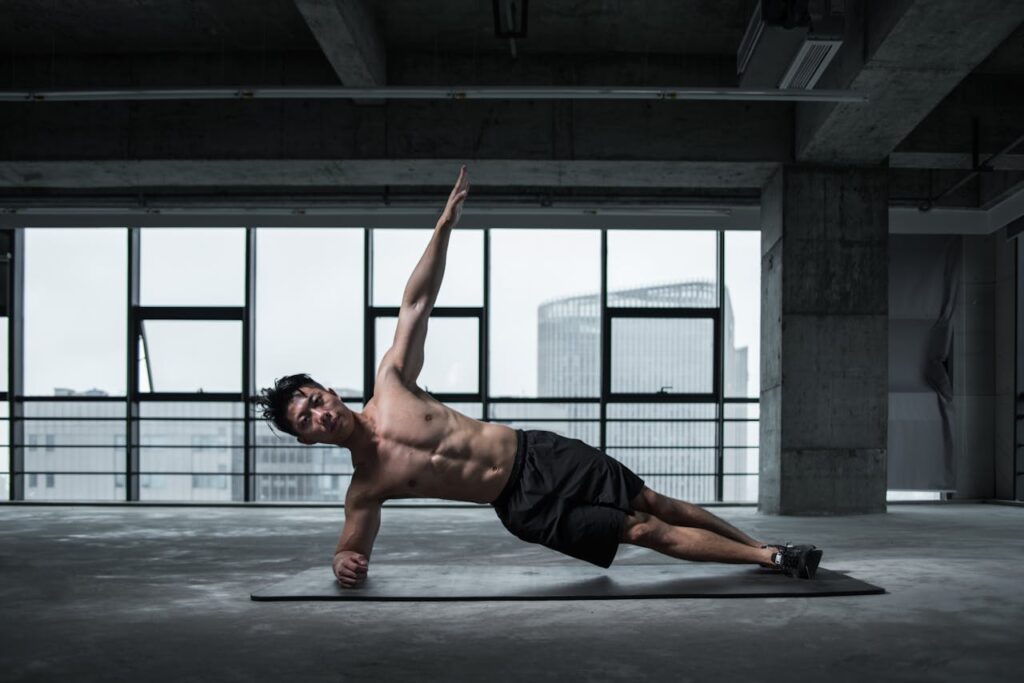
The side plank is one of the most effective yet underutilized exercises in fitness routines. While traditional planks get most of the attention, side planks offer unique benefits that can transform your core strength, improve your posture, and protect your spine from injury. This comprehensive guide will teach you everything you need to know about side planks, from proper form to advanced variations, ensuring you can safely incorporate this powerful exercise into your fitness routine.
What Is a Side Plank and Why Should You Care?
A side plank is an isometric core exercise performed by lying on your side and supporting your body weight with one arm while maintaining a straight line from head to feet. Unlike traditional crunches or sit-ups that primarily target the rectus abdominis (the “six-pack” muscles), side planks specifically engage the oblique muscles, which are crucial for rotational stability and lateral core strength.
The obliques consist of two layers: the external obliques (the outermost layer) and the internal obliques (the deeper layer). These muscles work together to provide spinal stability, assist in breathing, and enable rotational movements. When these muscles are weak, you’re more susceptible to lower back pain, poor posture, and movement compensations that can lead to injury.
The Science-Backed Benefits of Side Planks
1. Superior Oblique Muscle Activation
Research published in the Journal of Strength and Conditioning Research shows that side planks activate the oblique muscles significantly more than traditional ab exercises. While crunches primarily work the rectus abdominis, side planks create a more balanced approach to core strengthening by targeting the often-neglected lateral core muscles.
2. Enhanced Spinal Stability and Back Pain Prevention
Side planks strengthen the quadratus lumborum (QL), a deep muscle that runs along your lower back and plays a crucial role in spinal stability. A strong QL helps maintain proper spinal alignment and reduces the risk of lower back pain. Studies have shown that individuals with chronic lower back pain often have weakness in their lateral core muscles, making side planks an excellent therapeutic exercise.
3. Improved Functional Movement Patterns
Unlike isolation exercises, side planks train your core in a functional way that translates to real-world movements. Whether you’re carrying groceries, playing sports, or simply getting out of bed, your obliques and lateral core muscles are constantly working to stabilize your spine and transfer force between your upper and lower body.
4. Better Balance and Proprioception
Side planks challenge your balance and proprioception (your body’s awareness of its position in space) more than traditional planks. This improved balance translates to better athletic performance and reduced fall risk, particularly important for older adults.
5. Shoulder and Hip Stabilization
While primarily a core exercise, side planks also strengthen the shoulder stabilizers and hip abductors. The supporting arm develops strength in the serratus anterior and rotator cuff muscles, while the bottom leg’s hip abductors work to maintain proper alignment.
6. Time-Efficient Full-Body Engagement
Side planks provide maximum benefit in minimal time. A single exercise engages multiple muscle groups simultaneously, making it perfect for busy individuals who want effective workouts without spending hours in the gym.
How to Perform a Side Plank: Step-by-Step Instructions
Basic Side Plank Technique
Starting Position:
- Lie on your right side with your legs straight and stacked on top of each other
- Place your right elbow directly under your right shoulder, with your forearm flat on the ground
- Keep your left arm either on your hip or extended toward the ceiling
Execution:
- Engage your core muscles by drawing your belly button toward your spine
- Lift your hips off the ground, creating a straight line from your head to your feet
- Keep your body in perfect alignment – avoid letting your hips sag or pike up
- Hold this position while breathing normally
- Lower your hips back to the starting position with control
- Repeat on the opposite side
Proper Alignment Cues
- Head Position: Keep your neck in neutral alignment with your spine
- Shoulder Stability: Press your supporting elbow firmly into the ground
- Core Engagement: Maintain tension in your abdominal muscles throughout the hold
- Hip Alignment: Keep your hips stacked and avoid rotating forward or backward
- Leg Position: Keep your legs straight and engaged, with feet stacked
Side Plank Progressions and Modifications
Beginner Modifications
1. Modified Side Plank (Knees Down)
If you’re new to side planks or building strength, start with your knees on the ground instead of your feet. This reduces the load while still engaging the target muscles effectively.
2. Wall-Assisted Side Plank
Stand arm’s length from a wall and perform the side plank against the wall. This provides additional support while you develop proper form and strength.
3. Incline Side Plank
Place your supporting elbow on an elevated surface like a bench or step. The higher the surface, the easier the exercise becomes.
Intermediate Variations
1. Side Plank with Leg Lift
From the basic side plank position, lift your top leg 6-12 inches while maintaining the plank. This increases the challenge to your hip abductors and core stability.
2. Side Plank Dips
Start in a side plank position, then lower your hip toward the ground without touching it, and return to the starting position. This adds a dynamic component to the exercise.
3. Side Plank Rotations
From the side plank position, thread your top arm under your body and then return it to the starting position. This adds rotational movement and increases oblique activation.
Advanced Progressions
1. Elevated Side Plank
Place your feet on an elevated surface like a bench or stability ball. This increases the difficulty by adding instability and changing the angle of resistance.
2. Side Plank with Resistance
Add resistance bands or hold a weight in your top hand to increase the challenge.
3. Dynamic Side Plank Variations
Incorporate movements like reaching under your body, leg circles, or arm movements while maintaining the side plank position.
Programming Side Planks: Sets, Reps, and Frequency
For Beginners
- Duration: Start with 15-30 second holds
- Sets: 2-3 sets per side
- Frequency: 2-3 times per week
- Progression: Increase hold time by 5-10 seconds weekly
For Intermediate Practitioners
- Duration: 30-60 second holds
- Sets: 3-4 sets per side
- Frequency: 3-4 times per week
- Progression: Add variations or increase hold time
For Advanced Athletes
- Duration: 60+ second holds or dynamic variations
- Sets: 3-5 sets per side
- Frequency: 4-5 times per week
- Progression: Focus on advanced variations and loaded movements
Common Mistakes and How to Avoid Them
1. Hip Sagging
The Problem: Allowing your hips to drop toward the ground reduces the effectiveness and can strain your lower back.
The Solution: Focus on lifting your hips up and maintaining a straight line from head to feet.
2. Rolling Forward or Backward
The Problem: Rotating your torso breaks proper alignment and reduces muscle activation.
The Solution: Keep your shoulders, hips, and feet in the same plane throughout the exercise.
3. Holding Your Breath
The Problem: Breath-holding creates unnecessary tension and reduces exercise duration.
The Solution: Breathe normally throughout the hold, focusing on maintaining core engagement.
4. Neglecting the Supporting Shoulder
The Problem: Not properly engaging the supporting shoulder can lead to instability and potential injury.
The Solution: Press your elbow firmly into the ground and engage your shoulder blade muscles.
5. Pushing Through Pain
The Problem: Continuing to hold the position when form breaks down reduces effectiveness and increases injury risk.
The Solution: End the set when you can no longer maintain proper form, even if you haven’t reached your target time.
Safety Considerations and Contraindications
When to Avoid Side Planks
- Recent shoulder, elbow, or wrist injuries
- Acute lower back pain or injury
- Pregnancy (consult with healthcare provider)
- Severe osteoporosis
Safety Tips
- Always warm up before performing side planks
- Start with shorter holds and progress gradually
- Stop immediately if you experience pain
- Focus on quality over quantity
- Consider working with a qualified trainer if you’re unsure about form
Integrating Side Planks into Your Workout Routine
As Part of a Core Circuit
Combine side planks with other core exercises like regular planks, dead bugs, and bird dogs for a comprehensive core workout.
Pre-Workout Activation
Use side planks as part of your warm-up to activate your core muscles before more complex movements.
Post-Workout Finisher
End your workout with side plank holds to ensure your core is fully fatigued and strengthened.
Standalone Core Sessions
Dedicate specific sessions to core training, using side planks as a primary exercise with various progressions.
Side Planks for Special Populations
Athletes
Athletes can benefit from sport-specific side plank variations that mimic movement patterns in their sport. For example, tennis players might focus on rotational variations, while runners might emphasize stability holds.
Seniors
Older adults should start with modified versions and focus on balance and stability benefits. Wall-assisted or seated variations may be appropriate starting points.
Post-Injury Rehabilitation
Side planks are commonly used in physical therapy for lower back rehabilitation. Always work with a healthcare provider to ensure appropriate progression.
Frequently Asked Questions
How long should I hold a side plank?
Beginners should start with 15-30 seconds and gradually work up to 60 seconds or more. Quality is more important than duration – it’s better to hold perfect form for 20 seconds than poor form for 60 seconds.
Are side planks better than regular planks?
Both exercises have unique benefits. Regular planks primarily target the front core muscles, while side planks focus on the lateral core. A well-rounded routine should include both variations.
Can side planks help with lower back pain?
Yes, side planks can help strengthen the muscles that support your spine, potentially reducing lower back pain. However, if you have acute back pain, consult with a healthcare provider before starting any exercise program.
How often should I do side planks?
Most people can safely perform side planks 3-4 times per week, allowing for adequate recovery between sessions. Listen to your body and adjust frequency based on your fitness level and recovery needs.
What muscles do side planks work?
Side planks primarily target the obliques, quadratus lumborum, and transverse abdominis. They also engage the shoulder stabilizers, hip abductors, and various other core muscles for stability.
Conclusion: Make Side Planks Your Secret Weapon
Side planks are a versatile, effective exercise that deserves a place in every fitness routine. From beginners looking to build core strength to advanced athletes seeking performance enhancement, side planks offer scalable benefits that translate to improved function, reduced injury risk, and better overall fitness.
Remember, consistency is key. Start with the basic version, focus on perfect form, and gradually progress to more challenging variations. Your core, spine, and overall movement quality will thank you.
Ready to transform your core strength? Start incorporating side planks into your routine today, beginning with just 2-3 sets of 15-30 second holds on each side. As you build strength and confidence, explore the various progressions and modifications to keep your workouts challenging and effective.
Your journey to a stronger, more stable core starts with a single side plank. Make it count.