Resistance band squats have revolutionized home fitness routines, offering an accessible yet highly effective way to build lower body strength and muscle definition. Whether you’re a fitness beginner looking to master proper squat form or an experienced athlete seeking to add variety to your training, banded squats provide unique benefits that traditional bodyweight squats simply can’t match.
This comprehensive guide explores the science-backed benefits of resistance band squats, walks you through nine powerful variations, and provides expert programming strategies to maximize your results.
What Are Banded Squats?
Banded squats are squat variations performed with resistance bands to add external load and create accommodating resistance throughout the movement. Unlike traditional weights that provide constant resistance, resistance bands create variable tension that increases as the band stretches, challenging your muscles differently during both the eccentric (lowering) and concentric (lifting) phases of the squat.
The beauty of banded squats lies in their versatility. You can use loop bands around your thighs to target hip abductors, anchor bands to create upward resistance, or combine bands with traditional weights for advanced training protocols.
Benefits of Banded Squats
Enhanced Muscle Activation
Research shows that resistance bands provide unique muscle activation patterns compared to free weights. The accommodating resistance forces your muscles to work harder at the top of the squat movement, where you’re naturally stronger, while still providing adequate stimulus at the bottom position.
Key muscle groups targeted include:
- Glutes: Primary movers, especially the gluteus maximus and medius
- Quadriceps: Front thigh muscles responsible for knee extension
- Hip adductors: Inner thigh muscles that stabilize the pelvis
- Core muscles: Deep stabilizers that maintain proper posture
- Hamstrings: Posterior thigh muscles that assist in hip extension
Improved Movement Quality
Banded squats excel at teaching proper movement patterns. Loop bands placed around the thighs create external resistance that forces you to actively push your knees out, preventing the common fault of knee valgus (knees caving inward). This neuromuscular re-education translates to better squat mechanics in all your training.
Joint-Friendly Resistance
Unlike heavy barbells that load your spine from the start of the movement, resistance bands provide a more joint-friendly loading pattern. The variable resistance means less stress on your joints at the bottom of the squat while still providing significant muscle activation throughout the range of motion.
Accommodating Resistance Benefits
The unique strength curve of resistance bands matches your natural strength curve better than traditional weights. As you rise from the bottom of the squat, both your mechanical advantage and the band tension increase simultaneously, creating optimal muscle tension throughout the entire movement.
Portability and Convenience
Resistance bands are incredibly portable and versatile, making them perfect for home workouts, travel, or outdoor training sessions. A complete set of resistance bands weighs less than five pounds but can provide resistance equivalent to hundreds of pounds of traditional weights.
Types of Resistance Bands for Squats
Loop Bands (Mini Bands)
These continuous loops of elastic material are perfect for lateral resistance and glute activation. They typically provide 10-50 pounds of resistance and are ideal for beginners to intermediate users.
Best for: Hip abductor strengthening, glute activation, movement quality improvement
Long Loop Bands
Larger circumference bands that can be used around the thighs or anchored to create vertical resistance. These typically provide 20-100 pounds of resistance.
Best for: Anchored squats, full-body resistance training, advanced variations
Tube Bands with Handles
These bands feature comfortable handles and can be anchored or held during exercises. Resistance ranges from 10-150 pounds depending on the band thickness.
Best for: Goblet squats, overhead squats, combination movements
How to Choose the Right Resistance Level
Selecting appropriate resistance is crucial for both safety and effectiveness:
- Beginners: Start with light resistance (10-25 pounds equivalent)
- Intermediate: Progress to medium resistance (25-50 pounds equivalent)
- Advanced: Use heavy resistance (50+ pounds equivalent) or combine multiple bands
Always prioritize proper form over resistance level. You should be able to complete 8-12 repetitions with good technique while feeling challenged in the final 2-3 reps.
9 Effective Banded Squat Variations
1. Standard Banded Squat
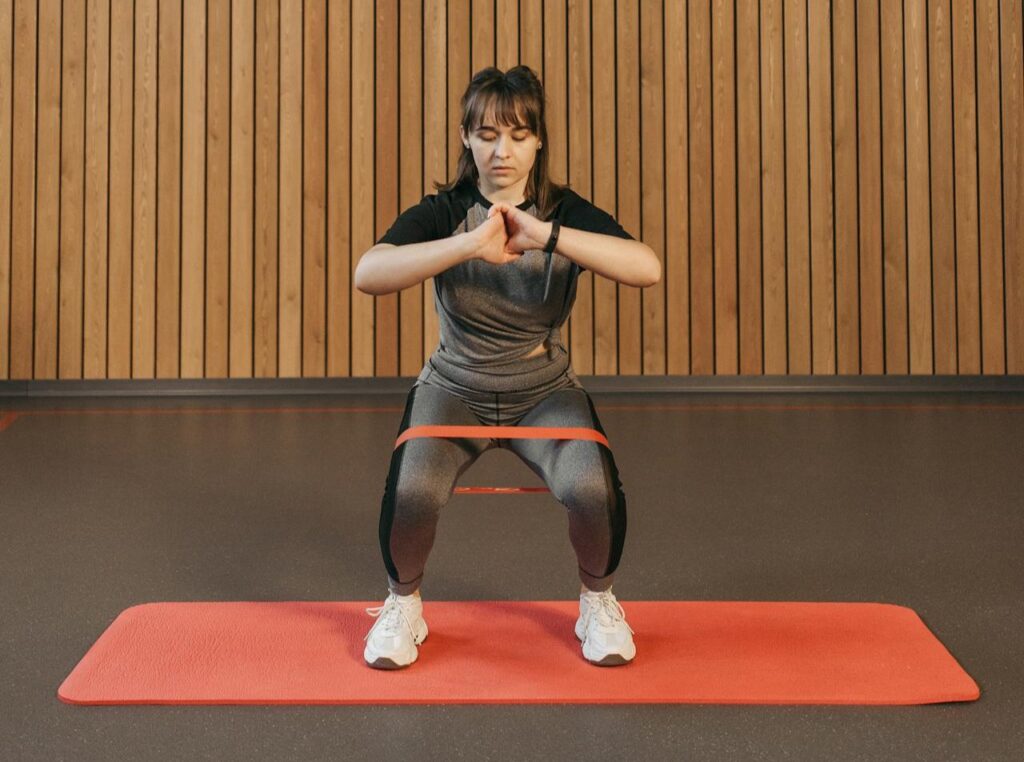
Setup: Place a loop band around your thighs, just above the knees.
Execution:
- Stand with feet shoulder-width apart, toes slightly turned out
- Engage your core and maintain a neutral spine
- Push your hips back and bend your knees to lower into a squat
- Keep your knees pressed out against the band resistance
- Lower until your thighs are parallel to the floor
- Drive through your heels to return to starting position
Sets/Reps: 3 sets of 12-15 repetitions
Focus: Glute activation and proper knee tracking
2. Banded Sumo Squat
Setup: Place a loop band around your thighs with feet wider than shoulder-width apart.
Execution:
- Turn your toes out 45 degrees
- Keep your torso upright as you squat down
- Focus on pushing your knees out against the band
- Squeeze your glutes at the top of the movement
Sets/Reps: 3 sets of 10-12 repetitions
Focus: Inner thigh and glute medius strengthening
3. Anchored Resistance Band Squat
Setup: Anchor a long resistance band at chest height and hold handles at shoulder level.
Execution:
- Step back to create tension in the band
- Perform a squat while maintaining tension in your arms
- The band will assist you up while providing resistance on the way down
- Focus on controlled movement in both directions
Sets/Reps: 3 sets of 8-10 repetitions
Focus: Eccentric strength and movement control
4. Banded Goblet Squat
Setup: Hold a resistance band handle in both hands at chest level, with the band anchored below you.
Execution:
- Keep your elbows close to your body
- Squat down while maintaining tension in the band
- The band provides upward resistance throughout the movement
- Focus on keeping your chest up and core engaged
Sets/Reps: 3 sets of 10-12 repetitions
Focus: Core stability and upper body engagement
5. Banded Pulse Squat
Setup: Place a loop band around your thighs and assume a half-squat position.
Execution:
- Hold the bottom position of a squat
- Perform small pulsing movements up and down (2-3 inches)
- Maintain constant tension in your glutes and thighs
- Keep your knees pressed out against the band
Sets/Reps: 3 sets of 15-20 pulses
Focus: Muscular endurance and glute activation
6. Banded Split Squat
Setup: Place a loop band around your thighs and step into a lunge position.
Execution:
- Keep most of your weight on your front leg
- Lower your back knee toward the ground
- Push your front knee out against the band resistance
- Drive through your front heel to return to starting position
Sets/Reps: 3 sets of 8-10 per leg
Focus: Unilateral strength and stability
7. Lateral Band Walk Squat
Setup: Place a loop band around your thighs and assume a quarter-squat position.
Execution:
- Maintain the squat position throughout the movement
- Step laterally while keeping tension in the band
- Take 10-15 steps in one direction, then reverse
- Keep your knees pressed out and core engaged
Sets/Reps: 3 sets of 10-15 steps each direction
Focus: Hip abductor strength and lateral stability
8. Banded Jump Squat
Setup: Place a loop band around your thighs for added glute activation.
Execution:
- Perform a regular squat with the band
- Explode upward into a jump
- Land softly and immediately descend into the next squat
- Maintain knee alignment throughout the movement
Sets/Reps: 3 sets of 6-8 repetitions
Focus: Power development and plyometric training
9. Single-Leg Banded Squat
Setup: Place a loop band around your thighs and lift one foot off the ground.
Execution:
- Balance on one leg while maintaining band tension
- Squat down as far as possible while maintaining balance
- Use your arms for counterbalance
- Focus on controlled movement and stability
Sets/Reps: 2 sets of 5-8 per leg
Focus: Unilateral strength and balance
Progressive Overload Strategies with Resistance Bands
Increase Resistance
- Use thicker bands or combine multiple bands
- Pre-stretch the band before starting the exercise
- Choose bands with higher resistance ratings
Increase Volume
- Add more sets or repetitions
- Increase training frequency from 2-3 times per week
- Incorporate multiple squat variations in one session
Increase Time Under Tension
- Slow down the eccentric (lowering) phase to 3-4 seconds
- Add pause reps at the bottom of the squat
- Perform isometric holds at challenging positions
Advanced Programming Techniques
- Drop sets: Start with heavy resistance and immediately switch to lighter bands
- Cluster sets: Perform mini-sets with short rest periods
- Mechanical drop sets: Progress from harder to easier squat variations
Common Mistakes and How to Avoid Them
Knee Valgus (Knees Caving In)
Problem: Allowing knees to collapse inward during the squat
Solution: Focus on pushing knees out against the band resistance throughout the entire movement
Inadequate Depth
Problem: Not squatting deep enough to maximize muscle activation
Solution: Aim for thighs parallel to the floor or deeper if mobility allows
Forward Lean
Problem: Excessive forward torso lean that shifts load away from target muscles
Solution: Keep chest up, engage core, and initiate movement with hip hinge
Rushing Through Reps
Problem: Performing repetitions too quickly without control
Solution: Focus on 2-second descent, 1-second pause, 2-second ascent
Ignoring Band Tension
Problem: Allowing the band to go slack during the movement
Solution: Maintain constant tension in the band throughout the entire range of motion
Safety Considerations and Injury Prevention
Band Inspection and Maintenance
- Inspect bands regularly for nicks, tears, or weak spots
- Replace bands showing signs of wear
- Store bands away from sharp objects and extreme temperatures
- Clean bands regularly to prevent degradation
Proper Warm-Up Protocol
- General warm-up: 5-10 minutes of light cardio
- Dynamic stretching: Leg swings, hip circles, walking lunges
- Activation exercises: Glute bridges, clamshells with light resistance
- Movement preparation: Bodyweight squats before adding band resistance
Listen to Your Body
- Start with lighter resistance and progress gradually
- Stop if you experience joint pain (muscle fatigue is normal)
- Allow adequate recovery between training sessions
- Modify exercises if you have existing injuries or limitations
Sample Banded Squat Workout Programs
Beginner Program (2-3 times per week)
Workout A:
- Standard Banded Squat: 3 sets of 12-15
- Banded Sumo Squat: 2 sets of 10-12
- Lateral Band Walk: 2 sets of 10 steps each direction
Workout B:
- Banded Goblet Squat: 3 sets of 10-12
- Banded Split Squat: 2 sets of 8 per leg
- Banded Pulse Squat: 2 sets of 15 pulses
Intermediate Program (3-4 times per week)
Day 1 – Strength Focus:
- Anchored Band Squat: 4 sets of 8-10
- Banded Sumo Squat: 3 sets of 10-12
- Single-Leg Banded Squat: 3 sets of 6-8 per leg
Day 2 – Power Focus:
- Banded Jump Squat: 4 sets of 6-8
- Lateral Band Walk Squat: 3 sets of 12 steps each direction
- Banded Pulse Squat: 3 sets of 20 pulses
Advanced Program (4-5 times per week)
Incorporate multiple band resistances, combination movements, and advanced programming techniques like drop sets and cluster training.
Frequently Asked Questions
Can resistance band squats replace weighted squats?
While resistance band squats offer unique benefits, they work best as a complement to traditional weighted squats rather than a complete replacement. Bands excel at muscle activation and movement quality, while weights provide consistent resistance for maximum strength development.
How often should I do banded squats?
Beginners can perform banded squats 2-3 times per week, while more advanced trainees can incorporate them 4-5 times per week. Allow at least 48 hours of recovery between intense sessions targeting the same muscle groups.
What resistance level should I start with?
Begin with light to medium resistance that allows you to complete 12-15 repetitions with proper form. You should feel challenged in the last 2-3 reps but still maintain good technique throughout the set.
Can I do banded squats every day?
Light resistance band squats can be performed daily as part of a warm-up or activation routine. However, higher-intensity sessions should be spaced out to allow for proper recovery and adaptation.
Are banded squats good for rehabilitation?
Yes, banded squats are excellent for rehabilitation due to their joint-friendly resistance profile and ability to improve movement patterns. However, always consult with a healthcare professional before using exercise for injury recovery.
The Bottom Line
Banded squats represent a powerful addition to any fitness routine, offering unique benefits that complement traditional training methods. From enhanced muscle activation and improved movement quality to convenient portability and joint-friendly resistance, resistance bands provide an accessible path to stronger, more functional lower body strength.
The nine variations outlined in this guide offer progression options for every fitness level, while the programming strategies ensure continued adaptation and results. Remember to prioritize proper form over resistance level, progress gradually, and listen to your body throughout your training journey.
Ready to transform your lower body training? Start with the basic banded squat today and gradually incorporate more challenging variations as your strength and movement quality improve. Your glutes, quads, and overall functional fitness will thank you for making this simple yet effective addition to your workout routine.