
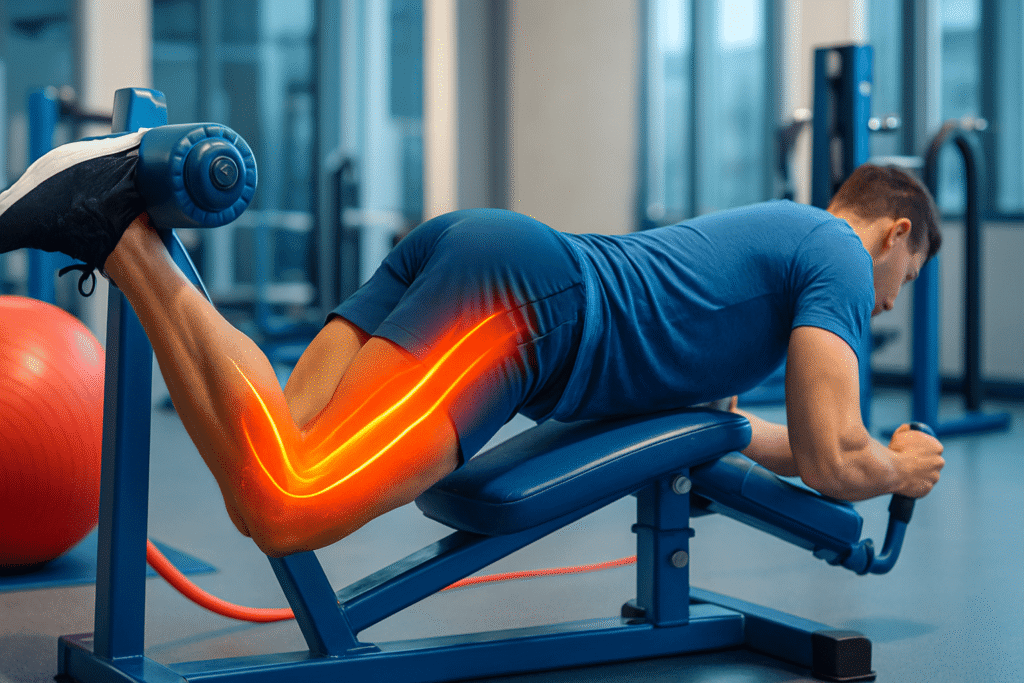
Building powerful, well-defined thighs requires more than just squats and lunges. Your hamstring muscles—the often-overlooked posterior chain powerhouses—play a crucial role in leg strength, athletic performance, and injury prevention. Hamstring curls are among the most effective exercises for targeting these vital muscles, and mastering different variations can transform your lower body training.
Whether you’re a beginner looking to strengthen your legs or an experienced athlete seeking to enhance your posterior chain development, this comprehensive guide will walk you through five essential hamstring curl variations that deliver results.
Understanding Your Hamstring Muscles
Before diving into the exercises, it’s essential to understand what you’re working. Your hamstrings consist of three distinct muscles:
- Biceps femoris: The largest hamstring muscle with two heads (long and short)
- Semitendinosus: Located on the inner side of your thigh
- Semimembranosus: Positioned beneath the semitendinosus
These muscles work together to flex your knee, extend your hip, and stabilize your pelvis during movement. Strong hamstrings are crucial for explosive movements, proper posture, and protecting your knees from injury.
Benefits of Hamstring Curls
Incorporating hamstring curls into your training routine offers numerous advantages:
Enhanced Athletic Performance
Strong hamstrings contribute to more powerful sprinting, jumping, and cutting movements. They work synergistically with your glutes to generate explosive hip extension—essential for athletic activities.
Injury Prevention
Well-developed hamstrings help prevent common injuries like ACL tears and hamstring strains. They provide crucial knee stabilization and help maintain proper muscle balance with your quadriceps.
Improved Deadlift Strength
Hamstring curls directly translate to stronger deadlifts by enhancing your ability to maintain proper hip hinge mechanics and generate force through the posterior chain.
Better Posture and Pelvic Stability
Strong hamstrings help counteract the effects of prolonged sitting by supporting proper pelvic alignment and reducing lower back stress.
Muscle Hypertrophy and Definition
Targeted hamstring training creates well-rounded thigh development, contributing to the coveted “teardrop” shape and overall leg aesthetics.
5 Essential Hamstring Curl Variations
1. Seated Hamstring Curl
The seated hamstring curl is an excellent starting point for beginners and provides consistent resistance throughout the range of motion.
How to Perform:
- Adjust the machine so your knees align with the pivot point
- Position the ankle pad just above your heels
- Sit with your back firmly against the pad, core engaged
- Slowly curl your heels toward your glutes, focusing on squeezing your hamstrings
- Pause briefly at the bottom, then return to starting position with control
Key Form Cues:
- Keep your core tight throughout the movement
- Avoid using your calves to assist the movement
- Maintain steady breathing—exhale during the curl, inhale on the return
Programming: 3-4 sets of 12-15 repetitions
2. Lying (Prone) Hamstring Curl
This variation allows for a greater range of motion and often feels more natural for many trainees.
How to Perform:
- Lie face down on the leg curl machine
- Position the ankle pad just above your heels
- Grip the handles for stability
- Curl your heels toward your glutes while keeping your hips pressed into the pad
- Squeeze your hamstrings at the top, then lower with control
Key Form Cues:
- Keep your hips pressed firmly into the pad
- Avoid lifting your hips or arching your back excessively
- Focus on a slow, controlled eccentric (lowering) phase
Programming: 3-4 sets of 10-12 repetitions
3. Standing Single-Leg Hamstring Curl
This unilateral variation improves balance, addresses muscle imbalances, and provides functional strength benefits.
How to Perform:
- Stand facing the cable machine with ankle strap attached to your working leg
- Hold onto the machine for balance
- Keep your standing leg slightly bent and core engaged
- Curl your heel toward your glute while maintaining hip stability
- Lower with control and repeat
Key Form Cues:
- Keep your working thigh perpendicular to the floor
- Avoid swinging or using momentum
- Maintain level hips throughout the movement
Programming: 3 sets of 8-10 repetitions per leg
4. Stability Ball Hamstring Curl
This bodyweight variation challenges your core stability while effectively targeting your hamstrings.
How to Perform:
- Lie on your back with your heels on top of a stability ball
- Lift your hips into a bridge position
- Keep your core tight and pull the ball toward your glutes using your heels
- Slowly extend your legs back to starting position while maintaining the bridge
Key Form Cues:
- Keep your hips elevated throughout the entire set
- Focus on pulling with your hamstrings, not pushing with your feet
- Maintain a straight line from knees to shoulders
Programming: 3 sets of 12-15 repetitions
5. Resistance Band Hamstring Curl
Perfect for home workouts or as a warm-up exercise, this variation provides variable resistance.
How to Perform:
- Lie face down with a resistance band looped around your ankles
- Anchor the band to a sturdy object in front of you
- Keep your thighs pressed to the floor
- Curl your heels toward your glutes against the band’s resistance
- Return to starting position with control
Key Form Cues:
- Keep constant tension on the band
- Don’t let your thighs lift off the floor
- Focus on the squeeze at the top of the movement
Programming: 3-4 sets of 15-20 repetitions
Advanced Progression Techniques
Eccentric Emphasis
Slow down the lowering phase of any hamstring curl to 3-4 seconds. This eccentric emphasis increases muscle damage and promotes greater hypertrophy.
Unilateral Training Benefits
Incorporating single-leg variations helps:
- Identify and correct muscle imbalances
- Improve proprioception and balance
- Increase core stability demands
- Enhance sport-specific movement patterns
Periodization Strategies
- Strength Phase: 3-5 sets of 5-8 reps with heavier resistance
- Hypertrophy Phase: 3-4 sets of 8-12 reps with moderate weight
- Endurance Phase: 2-3 sets of 15-20 reps with lighter resistance
Common Mistakes to Avoid
Using Too Much Weight
Starting with excessive resistance compromises form and reduces the exercise’s effectiveness. Focus on perfect technique before increasing load.
Neglecting the Eccentric Phase
The lowering portion of the movement is crucial for muscle development. Control the weight down rather than letting it drop.
Incomplete Range of Motion
Ensure you’re achieving full knee flexion at the top and complete extension at the bottom for maximum muscle activation.
Calf Involvement
Keep your feet relaxed and focus on pulling with your hamstrings rather than pointing your toes.
Programming and Workout Integration
Frequency
Train hamstrings 2-3 times per week, allowing at least 48 hours between sessions for recovery.
Workout Placement
- Primary Focus: Perform hamstring curls early in your leg workout when you’re fresh
- Accessory Work: Use them after compound movements like deadlifts or squats
- Rehabilitation: Include them in warm-up routines for injury prevention
Sample Hamstring Curl Workout
- Lying Hamstring Curl: 4 sets × 10-12 reps
- Standing Single-Leg Curl: 3 sets × 8-10 reps each leg
- Stability Ball Curl: 3 sets × 12-15 reps
- Resistance Band Curl: 2 sets × 15-20 reps (finisher)
Sport-Specific Applications
For Runners
Strong hamstrings improve stride efficiency and reduce injury risk. Focus on higher-rep ranges (15-20) to build endurance.
For Athletes
Emphasize explosive concentric contractions and controlled eccentrics to enhance power and deceleration abilities.
For Bodybuilders
Use a variety of rep ranges and angles to maximize muscle development and create well-rounded thigh aesthetics.
Equipment Alternatives for Home Training
Don’t have access to a gym? These alternatives work effectively:
- Towel slides on hardwood floors
- Suspension trainer hamstring curls
- Dumbbell between your feet for added resistance
- Ankle weights for standing variations
Conclusion
Mastering these five hamstring curl variations will significantly enhance your lower body strength, athletic performance, and injury resilience. Remember that consistency and progressive overload are key to seeing results. Start with bodyweight or light resistance, focus on perfect form, and gradually increase the challenge as your strength improves.
Strong hamstrings are the foundation of powerful, well-balanced legs. By incorporating these exercises into your routine and following proper programming principles, you’ll build the posterior chain strength necessary for athletic excellence and long-term joint health.
Ready to transform your leg training? Start with 2-3 of these variations and progressively add others as you master the movement patterns. Your future self will thank you for the investment in hamstring strength.
Frequently Asked Questions
Q: How often should I do hamstring curls?
A: Aim for 2-3 times per week with at least 48 hours of rest between sessions. This allows adequate recovery while maintaining consistent stimulus for growth.
Q: Should I do hamstring curls before or after squats?
A: For strength and hypertrophy goals, perform hamstring curls after compound movements like squats and deadlifts. For injury prevention or activation, light hamstring curls can be effective as part of your warm-up.
Q: What’s the difference between seated and lying hamstring curls?
A: Seated curls emphasize the lower portion of the hamstrings due to hip flexion, while lying curls allow for greater range of motion and often feel more natural. Both are effective—variety is key.
Q: Can I build significant muscle with just bodyweight hamstring curls?
A: Yes, especially when starting out. Stability ball curls and single-leg variations can be quite challenging. As you progress, adding external resistance will be necessary for continued growth.
Q: How do I know if I’m using too much weight?
A: Signs include inability to control the eccentric phase, using momentum or swinging, incomplete range of motion, or feeling the exercise primarily in your calves rather than hamstrings. Reduce weight and focus on form.