
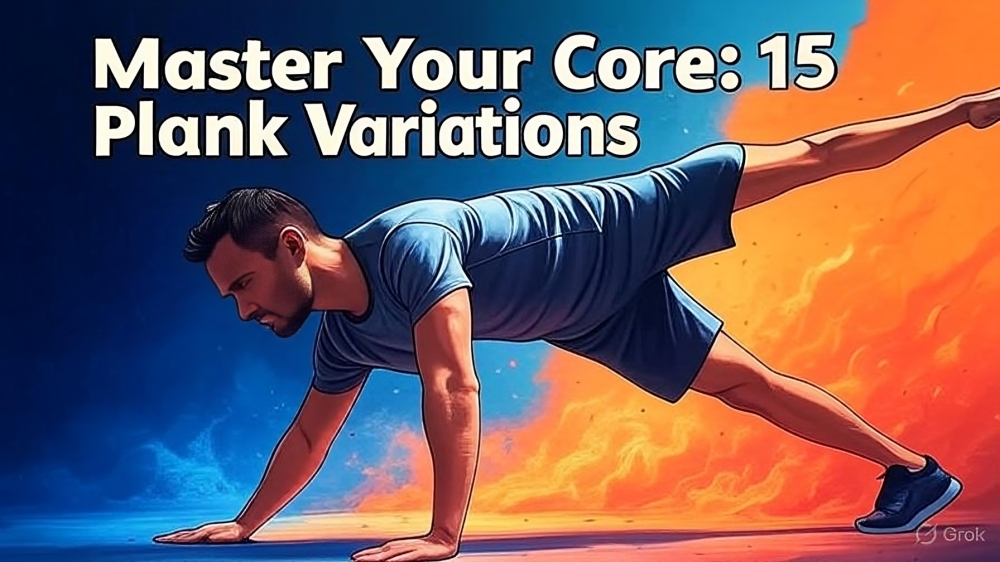
If you’ve been doing the same old plank for months (or years), it’s time to shake things up. While the traditional plank is undoubtedly effective, your core muscles are smart—they adapt quickly to repetitive movements, which means your progress can plateau faster than you’d like.
The solution? Diversifying your plank workout with challenging variations that target your core from every angle while engaging additional muscle groups. These 15 plank variations will not only prevent workout boredom but also accelerate your strength gains, improve your posture, and build the kind of functional fitness that translates to real-world activities.
Why Plank Variations Are Essential for Your Fitness Journey
Before we dive into the exercises, let’s understand why mixing up your plank routine is crucial for optimal results.
Multiple Muscle Group Engagement
While traditional planks primarily target your rectus abdominis (the “six-pack” muscles), variations engage your transverse abdominis, obliques, glutes, shoulders, and even your legs. This comprehensive muscle activation leads to better overall strength and stability.
Prevents Adaptation Plateau
Your body is incredibly efficient at adapting to repetitive stress. By introducing new movement patterns, you continuously challenge your muscles, ensuring consistent progress and strength gains.
Functional Fitness Benefits
These variations mimic real-world movements, improving your ability to perform daily activities with greater ease and reduced injury risk. From lifting groceries to playing with your kids, a strong, stable core is your foundation for everything.
Beginner-Friendly Plank Variations
1. Knee Plank
Perfect for building initial core strength and mastering proper plank form.
How to perform:
- Start on your hands and knees in a tabletop position
- Lower onto your forearms, keeping elbows directly under shoulders
- Engage your core and maintain a straight line from head to knees
- Hold for 15-30 seconds, gradually increasing duration
Pro tip: Focus on breathing steadily throughout the hold—this isn’t a breath-holding contest!
2. Incline Plank
Reduces the load on your core while still providing an effective workout.
How to perform:
- Place your hands on an elevated surface (bench, couch, or step)
- Step back into plank position with hands directly under shoulders
- Maintain straight body alignment from head to heels
- Hold for 20-45 seconds
Progression: Lower the incline height as you get stronger.
3. Wall Plank
An excellent starting point for absolute beginners or those recovering from injury.
How to perform:
- Stand arm’s length from a wall
- Place palms flat against the wall at shoulder height
- Step back slightly and lean into the wall, maintaining straight body alignment
- Hold for 30-60 seconds
Intermediate Plank Variations
4. Forearm Plank with Shoulder Taps
Adds anti-rotation challenge while maintaining plank position.
How to perform:
- Start in forearm plank position
- Lift one hand and tap the opposite shoulder
- Return to starting position and repeat with other hand
- Alternate for 10-20 taps per side
Key focus: Minimize hip movement and rotation throughout the exercise.
5. Plank with Leg Lifts
Targets glutes and hamstrings while challenging core stability.
How to perform:
- Begin in standard forearm plank
- Lift one leg 6-12 inches off the ground
- Hold for 2-3 seconds, then lower with control
- Alternate legs for 8-15 repetitions per side
6. Side Plank
Essential for targeting obliques and improving lateral core strength.
How to perform:
- Lie on your side with forearm on the ground, elbow under shoulder
- Stack your feet and lift hips off the ground
- Create a straight line from head to feet
- Hold for 15-45 seconds per side
Modification: Drop to your knees for reduced difficulty.
7. Reverse Plank
Targets posterior chain muscles often neglected in traditional planks.
How to perform:
- Sit with legs extended, hands behind you with fingers pointing toward feet
- Lift hips up, creating straight line from head to heels
- Squeeze glutes and engage core
- Hold for 15-30 seconds
Advanced Plank Variations
8. Plank Up-Downs
Dynamic movement that challenges strength and coordination.
How to perform:
- Start in forearm plank position
- Push up onto one hand, then the other, moving to full plank
- Lower back down to forearms, one arm at a time
- Complete 8-15 repetitions, alternating leading arm
9. Spider-Man Plank
Combines core stability with hip mobility and oblique strength.
How to perform:
- Begin in full plank position
- Bring right knee toward right elbow
- Return to starting position
- Repeat with left knee to left elbow
- Alternate for 10-20 repetitions per side
10. Plank Jacks
Adds cardiovascular challenge while maintaining core engagement.
How to perform:
- Start in full plank position
- Jump feet apart, then back together
- Maintain strong plank position throughout
- Complete 15-30 repetitions
11. Single-Arm Plank
Ultimate test of anti-rotation strength and stability.
How to perform:
- Begin in full plank position
- Lift one arm straight out in front of you
- Hold for 10-20 seconds
- Switch arms and repeat
Challenge: Try extending opposite arm and leg simultaneously.
12. Plank with Row
Requires equipment but provides excellent upper body and core integration.
How to perform:
- Start in plank position holding dumbbells or resistance band
- Row one arm back, squeezing shoulder blade
- Return with control and repeat on other side
- Complete 8-12 repetitions per arm
Expert-Level Plank Variations
13. Swiss Ball Pike
Combines core strength with shoulder stability and flexibility.
How to perform:
- Start in plank position with feet on stability ball
- Pike hips up toward ceiling, rolling ball toward hands
- Lower back to starting position with control
- Complete 8-15 repetitions
14. TRX Plank
Suspension trainer adds instability for increased core activation.
How to perform:
- Place feet in TRX straps
- Assume plank position with hands on ground
- Maintain position for 30-60 seconds
- Focus on preventing excessive sway or movement
15. Weighted Plank
Progressive overload for advanced practitioners.
How to perform:
- Assume forearm plank position
- Have partner place weight plate on your back
- Maintain perfect form for 20-45 seconds
- Start with light weight and progress gradually
Creating Your Plank Workout Program
Weekly Integration Strategy
Incorporate plank variations into your routine 3-4 times per week, allowing at least one day of rest between intense sessions. Here’s a sample progression:
Week 1-2: Focus on 3-4 beginner variations
Week 3-4: Add 2-3 intermediate variations
Week 5+: Introduce advanced variations while maintaining foundational movements
Progression Guidelines
- Beginners: Start with 15-30 second holds
- Intermediate: Work toward 45-60 second holds
- Advanced: Focus on 60+ seconds or increased repetitions for dynamic movements
Form Over Duration
Remember, 20 seconds of perfect form beats 60 seconds of sloppy execution. Quality movement patterns are your foundation for long-term success and injury prevention.
Maximizing Your Plank Training Results
Nutrition for Core Strength
While planks build muscle, revealing your hard work requires attention to nutrition. Focus on:
- Adequate protein intake (0.8-1g per pound of body weight)
- Staying hydrated for optimal muscle function
- Consuming anti-inflammatory foods to support recovery
Recovery and Mindfulness
Plank variations aren’t just physical exercises—they’re opportunities to practice mindfulness and body awareness. Focus on your breathing, notice muscle engagement, and use this time to connect with your body.
Integration with Other Training
These plank variations complement other fitness modalities beautifully:
- Yoga: Enhances poses requiring core stability
- Strength training: Improves compound lift performance
- Cardio: Builds endurance for longer training sessions
Common Mistakes to Avoid
- Holding your breath: Maintain steady breathing throughout
- Sagging hips: Keep core engaged to prevent lower back stress
- Rushing progressions: Master each variation before advancing
- Ignoring pain: Distinguish between muscle fatigue and joint discomfort
Frequently Asked Questions
How long should I hold each plank variation?
Start with 15-30 seconds for new variations, focusing on perfect form. Gradually increase duration as your strength improves. For dynamic variations, aim for 8-15 repetitions per side.
Can I do plank variations every day?
While planks are generally safe for daily practice, your core muscles need recovery time to grow stronger. Aim for 3-4 sessions per week with at least one rest day between intense workouts.
Which plank variation is best for beginners?
The knee plank and incline plank are excellent starting points. They allow you to build strength gradually while mastering proper form and breathing patterns.
How do I know when to progress to harder variations?
When you can hold a variation for 60 seconds with perfect form, or complete the recommended repetitions without fatigue, it’s time to progress to the next level.
Are plank variations safe during pregnancy?
Many plank variations can be modified for pregnancy, but always consult with your healthcare provider first. Wall planks and incline planks are generally safer options during later stages.
Your Next Steps to Core Strength Mastery
These 15 plank variations provide a comprehensive roadmap for building exceptional core strength, stability, and functional fitness. Start with variations that match your current fitness level, focus on perfect form, and progress gradually.
Remember, consistency trumps intensity every time. It’s better to perform 3-4 variations perfectly three times per week than to attempt all 15 variations with poor form.
Ready to transform your core strength? Choose 3-4 variations from this list, commit to practicing them for the next two weeks, and watch as your stability, posture, and overall fitness reach new heights. Your future self will thank you for building this foundation of strength that supports every aspect of your active lifestyle.