The power clean stands as one of the most effective full-body exercises for developing explosive strength, athletic performance, and functional power. This Olympic weightlifting movement has earned its place in training programs across sports, from football to CrossFit, due to its unparalleled ability to enhance power output and athletic performance.
Whether you’re a beginner looking to add explosive movement to your routine or an experienced lifter seeking to refine your technique, this comprehensive guide will walk you through every aspect of mastering the power clean safely and effectively.
What Is the Power Clean?
The power clean is a dynamic, explosive movement that involves lifting a loaded barbell from the floor to shoulder height in one fluid motion. Unlike the full clean, the power clean requires catching the bar in a partial squat position rather than a full squat, making it more accessible for athletes and fitness enthusiasts.
This compound exercise targets multiple muscle groups simultaneously, making it one of the most efficient movements for developing total-body strength and power. The power clean teaches your body to generate force rapidly, coordinate complex movement patterns, and develop the kind of explosive strength that translates directly to improved athletic performance.
How to Perform the Power Clean: The 5-Phase Breakdown
Phase 1: Starting Position and Setup
The foundation of a successful power clean begins with proper setup:
Bar Position:
- Position the barbell over the middle of your feet
- The bar should be approximately one inch from your shins
- Use a hook grip or overhand grip, hands positioned slightly wider than shoulder-width
Body Position:
- Feet hip-width apart, toes pointing slightly outward
- Chest up and shoulders positioned over or slightly in front of the bar
- Back straight with a natural arch in the lower back
- Knees bent, hips back in a deadlift-like position
- Arms straight with elbows pointing outward
Mental Preparation:
- Engage your core muscles
- Focus on maintaining tension throughout your entire body
- Visualize the explosive movement you’re about to perform
Phase 2: The First Pull
The first pull initiates the movement and sets the stage for explosive power generation:
- Drive through your heels and push the floor away
- Maintain the same torso angle as you lift the bar off the ground
- Keep the bar close to your body throughout the movement
- Your knees and hips should extend at the same rate
- The bar should travel in a straight vertical path
Key Focus Points:
- Don’t let your hips rise faster than your shoulders
- Maintain constant pressure against the bar
- Keep your shoulders over the bar as long as possible
Phase 3: The Second Pull and Triple Extension
This phase generates the explosive power that defines the power clean:
The Transition:
- As the bar passes your knees, begin to accelerate aggressively
- Your torso should become more upright
- The bar should remain close to your thighs
Triple Extension:
- Explosively extend your hips, knees, and ankles simultaneously
- This creates the “jump” that propels the bar upward
- Your body should reach full extension with the bar at mid-thigh level
- Think of this as jumping while keeping the bar close to your body
The High Pull:
- As you reach full extension, shrug your shoulders upward
- Begin pulling with your arms, leading with your elbows
- Your elbows should stay higher than your hands throughout the pull
Phase 4: The Catch Phase
The catch phase requires precise timing and positioning:
The Transition Under:
- As the bar reaches maximum height, quickly drop under it
- Rotate your elbows forward and up to create a “shelf” with your shoulders
- Your feet may move slightly wider than your starting position
The Catch Position:
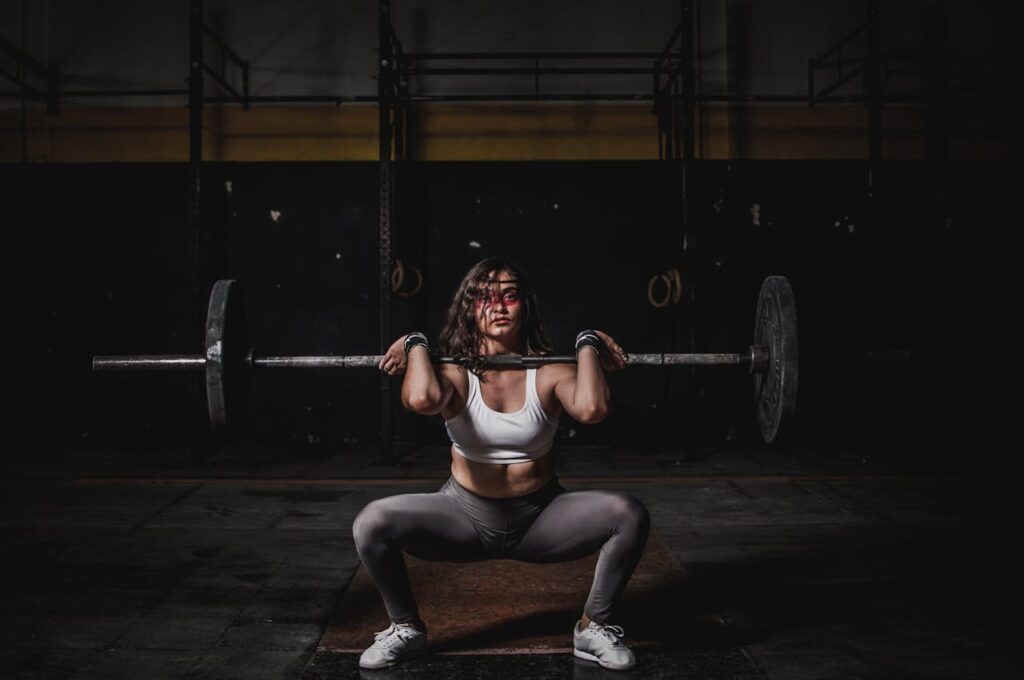
- Catch the bar in a partial front squat position
- The bar should rest on your anterior deltoids and clavicles
- Your elbows should point forward, creating stability
- Your knees should be bent, but not in a full squat
Stabilization:
- Absorb the weight by flexing at the hips and knees
- Maintain an upright torso
- Keep your core engaged for stability
Phase 5: The Recovery and Reset
Complete the movement with proper recovery:
- Stand up from the catch position by extending your hips and knees
- Keep the bar stable on your shoulders throughout the recovery
- Once standing, you can either perform additional reps or safely lower the bar
- To lower the bar, reverse the movement by guiding it down your body
Muscles Worked in the Power Clean
The power clean is truly a full-body exercise that targets multiple muscle groups:
Primary Movers:
- Glutes: Drive hip extension during the second pull
- Quadriceps: Extend the knees and provide power during the catch
- Hamstrings: Assist in hip extension and stabilization
- Calves: Contribute to the triple extension
Secondary Muscles:
- Core muscles: Provide stability throughout the entire movement
- Trapezius: Elevate the shoulders during the high pull
- Deltoids: Support the bar during the catch phase
- Forearms and grip muscles: Maintain control of the barbell
- Rhomboids and middle traps: Stabilize the shoulder blades
Benefits of the Power Clean
Enhanced Athletic Performance
Research consistently shows that power clean training improves:
- Vertical jump height: Studies indicate improvements of 10-15% after 8-12 weeks of training
- Sprint speed: Enhanced acceleration and maximum velocity
- Agility and change of direction: Improved neuromuscular coordination
- Overall power output: Increased rate of force development
Functional Strength Development
The power clean develops strength that transfers to real-world activities:
- Improved ability to lift and move objects explosively
- Enhanced coordination between upper and lower body
- Better posture and core stability
- Increased bone density through high-impact loading
Metabolic Benefits
Due to its high-intensity, full-body nature, the power clean:
- Burns significant calories during and after exercise
- Improves cardiovascular conditioning
- Enhances metabolic rate for hours post-workout
- Develops both strength and conditioning simultaneously
Programming the Power Clean in Your Training
Frequency and Volume
Beginners:
- 2-3 sessions per week
- 3-5 sets of 2-3 repetitions
- Focus on technique over weight
Intermediate/Advanced:
- 3-4 sessions per week
- 4-6 sets of 1-3 repetitions
- Can handle higher intensities and volumes
Periodization Strategies
Linear Progression:
- Gradually increase weight while maintaining proper form
- Add 2.5-5 pounds per week for beginners
- Focus on consistency and technique refinement
Undulating Periodization:
- Vary intensity and volume throughout the week
- Heavy days (85-95% 1RM), moderate days (70-80%), light days (60-70%)
- Allows for better recovery and adaptation
Integration with Other Exercises
The power clean works exceptionally well when combined with:
- Deadlifts: Build pulling strength foundation
- Front squats: Improve catch position strength
- High pulls: Develop the pulling portion
- Push press: Complement with overhead strength
Common Power Clean Mistakes and How to Fix Them
Mistake 1: Poor Starting Position
The Problem: Rounded back, bar too far from body, improper foot positioning
The Fix:
- Practice the setup position repeatedly
- Use a mirror or video to check your form
- Start with an unloaded barbell or PVC pipe
Mistake 2: Premature Arm Pull
The Problem: Using arms too early instead of relying on hip drive
The Fix:
- Focus on keeping arms straight during the first and second pulls
- Practice high pulls to emphasize proper sequencing
- Think “legs first, then arms”
Mistake 3: Forward Bar Path
The Problem: Bar drifts away from the body during the pull
The Fix:
- Keep the bar in contact with your legs throughout the pull
- Practice with lighter weights to groove the proper path
- Use chalk or lifting straps for better grip
Mistake 4: Inadequate Hip Extension
The Problem: Not fully extending the hips during the second pull
The Fix:
- Practice jump squats and broad jumps
- Focus on aggressive hip drive
- Use cues like “jump and shrug”
Mistake 5: Poor Catch Position
The Problem: Catching the bar on the hands instead of shoulders
The Fix:
- Practice front squats to improve catch position
- Work on thoracic spine mobility
- Practice the catch position without weight
Mobility Requirements and Troubleshooting
Essential Mobility Areas
Ankle Mobility:
- Perform calf stretches and ankle circles
- Use a slant board for dorsiflexion stretches
- Practice deep squats to improve ankle range of motion
Hip Mobility:
- Hip flexor stretches and 90/90 stretches
- Pigeon pose and couch stretch
- Dynamic warm-up with leg swings
Thoracic Spine Mobility:
- Cat-cow stretches and thoracic extensions
- Wall slides and band pull-aparts
- Foam rolling the upper back
Shoulder and Wrist Mobility:
- Overhead reaches and shoulder dislocations
- Wrist circles and prayer stretches
- Front rack position holds
Equipment Alternatives for Home Training
Limited Equipment Options:
- Dumbbell power cleans: Use heavy dumbbells for similar movement pattern
- Kettlebell swings: Develop hip drive and explosive power
- Medicine ball slams: Practice explosive triple extension
- Resistance band power cleans: Learn the movement pattern safely
Safety Considerations and Precautions
Who Should Avoid Power Cleans
Consult with a healthcare provider before performing power cleans if you have:
- Lower back injuries or chronic pain
- Shoulder impingement or rotator cuff issues
- Wrist or elbow problems
- Knee injuries or instability
Progressive Learning Approach
Week 1-2: Master the deadlift and front squat
Week 3-4: Learn the high pull movement
Week 5-6: Practice the catch position
Week 7-8: Combine all phases with light weight
Week 9+: Gradually increase intensity
Proper Warm-Up Protocol
Always begin with a comprehensive warm-up:
- 5-10 minutes of light cardio
- Dynamic stretching focusing on hips, shoulders, and ankles
- Activation exercises for glutes and core
- Movement preparation with PVC pipe or empty barbell
- Gradual load progression starting at 40-50% of working weight
Sport-Specific Applications
Football and Rugby
Power cleans directly translate to:
- Explosive starts and acceleration
- Tackling and blocking power
- Jumping ability for catching and defending
Track and Field
Benefits include:
- Improved sprint starts
- Enhanced jumping performance
- Better throwing power for field events
Basketball and Volleyball
Power clean training enhances:
- Vertical jump for rebounds and blocks
- Quick direction changes
- Explosive first steps
Frequently Asked Questions
How often should I perform power cleans?
For beginners, 2-3 times per week is optimal, allowing for proper recovery between sessions. Advanced athletes may train power cleans 4-5 times per week with varying intensities.
What weight should I start with?
Begin with just the barbell (45 pounds) or even a PVC pipe to master the movement pattern. Only add weight once you can perform 5 consecutive repetitions with perfect form.
Can I do power cleans if I have lower back problems?
Consult with a healthcare provider first. If cleared, start with very light weights and focus on perfect form. Consider alternatives like dumbbell power cleans or kettlebell swings.
How long does it take to learn proper power clean technique?
Most people need 4-8 weeks of consistent practice to develop basic proficiency. Mastering the movement can take several months to years, depending on training frequency and coaching quality.
Should I use lifting straps for power cleans?
Straps can be helpful for heavier weights or when grip strength is limiting. However, develop your natural grip strength first, as it’s an important component of the exercise.
Take Your Training to the Next Level
The power clean represents one of the most effective exercises for developing explosive strength, athletic performance, and functional power. By following this comprehensive guide and focusing on proper technique progression, you’ll be well on your way to mastering this game-changing movement.
Remember that consistency and patience are key to success with the power clean. Start with light weights, focus on perfect form, and gradually progress as your technique and strength improve. Consider working with a qualified coach, especially in the beginning stages, to ensure you’re developing proper movement patterns.
Whether your goal is improved athletic performance, increased strength, or enhanced functional fitness, the power clean deserves a place in your training program. Master this movement, and you’ll unlock new levels of explosive power that will benefit every aspect of your physical performance.
Ready to start your power clean journey? Begin with the mobility work and basic movement patterns outlined in this guide, and remember – every expert was once a beginner. Your dedication to proper technique and consistent practice will pay dividends in improved performance and reduced injury risk.