
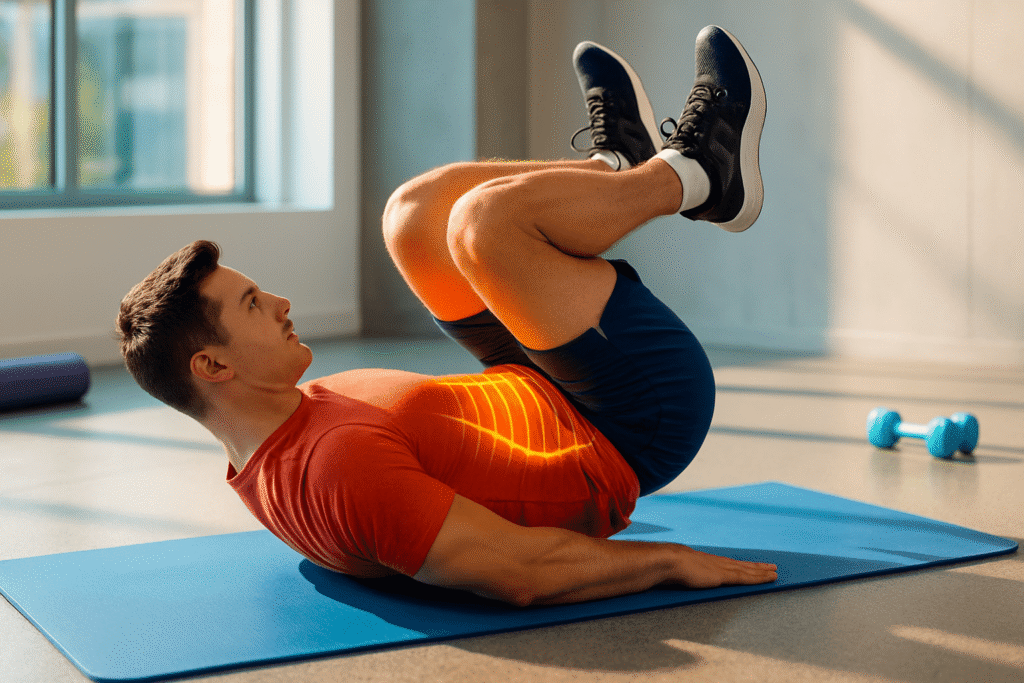
The reverse crunch is one of the most effective yet underutilized core exercises in fitness. While traditional crunches have dominated ab workouts for decades, the reverse crunch offers superior benefits for targeting your lower abdominal muscles while reducing strain on your neck and spine. This comprehensive guide will teach you everything you need to know about reverse crunches, from proper form to advanced variations that will transform your core training routine.
What Are Reverse Crunches and Why They Matter
Reverse crunches are a bodyweight exercise that involves lifting your hips and knees toward your chest while lying on your back. Unlike traditional crunches where you lift your shoulders off the ground, reverse crunches work from the bottom up, making them particularly effective for targeting the often-neglected lower portion of your rectus abdominis.
The exercise gets its name from the reversed movement pattern compared to standard crunches. Instead of bringing your upper body toward your legs, you bring your legs toward your upper body. This fundamental difference makes reverse crunches a game-changer for anyone looking to develop a stronger, more balanced core.
The Science-Backed Benefits of Reverse Crunches
Enhanced Lower Abdominal Activation
The primary benefit of reverse crunches lies in their ability to target the lower fibers of the rectus abdominis more effectively than traditional crunches. Research shows that the reverse crunch activates the lower abs up to 30% more than standard crunches, making it an essential exercise for developing that coveted lower ab definition.
Reduced Neck and Spine Strain
One of the most significant advantages of reverse crunches is their spine-friendly nature. Traditional crunches often lead to neck strain and excessive spinal flexion, which can contribute to disc problems over time. Reverse crunches eliminate neck involvement entirely and promote healthier spinal movement patterns.
Improved Pelvic Floor Strength
The reverse crunch movement naturally engages your pelvic floor muscles, which are crucial for core stability, posture, and overall functional strength. This makes reverse crunches particularly beneficial for women during pregnancy recovery and anyone looking to improve their foundational strength.
Better Posture and Spinal Health
By strengthening the deep core muscles and promoting proper pelvic alignment, reverse crunches contribute to better posture throughout your daily activities. A strong lower core helps maintain the natural curve of your spine and reduces the risk of lower back pain.
Functional Movement Enhancement
Unlike isolation exercises that work muscles in isolation, reverse crunches train your core in a way that translates to real-world movements. The hip flexion pattern mimics movements you perform daily, from getting out of bed to climbing stairs.
No Equipment Required
Reverse crunches require nothing more than floor space, making them accessible to everyone regardless of gym access or equipment availability. This convenience factor makes it easier to maintain consistency in your core training routine.
Muscles Worked During Reverse Crunches
Understanding which muscles reverse crunches target helps you appreciate their effectiveness and integrate them properly into your workout routine.
Primary Muscles
Rectus Abdominis: The “six-pack” muscle running from your ribcage to your pelvis. Reverse crunches particularly emphasize the lower fibers of this muscle.
Hip Flexors: These muscles, including the iliopsoas, help lift your knees toward your chest during the movement.
Secondary Muscles
Obliques: Both internal and external obliques assist in stabilizing your torso during the exercise.
Transverse Abdominis: Your deepest core muscle provides stability and helps maintain proper form throughout the movement.
Lower Back Muscles: These muscles work isometrically to maintain spinal alignment during the exercise.
How to Do Reverse Crunches Correctly: Step-by-Step Guide
Proper form is crucial for maximizing the benefits of reverse crunches while minimizing injury risk. Follow these detailed instructions for perfect execution.
Starting Position
- Lie flat on your back on a comfortable surface, preferably an exercise mat
- Place your arms at your sides with palms facing down for stability
- Bend your knees to approximately 90 degrees
- Lift your feet off the ground so your thighs are perpendicular to the floor
- Engage your core by gently drawing your navel toward your spine
The Movement
- Initiate the movement by slowly lifting your hips off the ground
- Bring your knees toward your chest in a controlled motion
- Focus on curling your pelvis upward rather than just lifting your legs
- Pause briefly at the top of the movement when your knees are closest to your chest
- Slowly lower your hips back to the starting position with control
- Maintain tension in your core throughout the entire range of motion
Breathing Pattern
- Exhale as you lift your hips and bring your knees toward your chest
- Inhale as you slowly return to the starting position
- Avoid holding your breath during any part of the movement
Programming Recommendations for Optimal Results
To maximize the benefits of reverse crunches, proper programming is essential. Here’s how to integrate them into your routine effectively.
Beginner Protocol
- Sets: 2-3 sets
- Repetitions: 8-12 reps
- Frequency: 2-3 times per week
- Rest: 30-45 seconds between sets
Intermediate Protocol
- Sets: 3-4 sets
- Repetitions: 12-15 reps
- Frequency: 3-4 times per week
- Rest: 30-60 seconds between sets
Advanced Protocol
- Sets: 4-5 sets
- Repetitions: 15-20 reps
- Frequency: 4-5 times per week
- Rest: 45-60 seconds between sets
Common Form Mistakes to Avoid
Even with detailed instructions, certain mistakes can compromise the effectiveness of reverse crunches and increase injury risk.
Using Momentum
The Mistake: Swinging your legs up quickly instead of using controlled muscle contraction.
The Fix: Focus on slow, deliberate movements. Take 2-3 seconds to lift and 2-3 seconds to lower.
Lifting Too High
The Mistake: Bringing your knees too far toward your head, which can strain your lower back.
The Fix: Stop when your knees reach your chest level. The movement should be subtle and controlled.
Neglecting the Negative
The Mistake: Dropping your legs quickly after the lifting phase.
The Fix: Control the lowering phase just as carefully as the lifting phase for maximum muscle engagement.
Holding Your Breath
The Mistake: Forgetting to breathe during the exercise.
The Fix: Establish a consistent breathing pattern and stick to it throughout your set.
Pressing with Your Arms
The Mistake: Using your arms to push yourself up instead of relying on core strength.
The Fix: Keep your arms relaxed and focus on initiating movement from your core muscles.
Modifications and Progressions
Beginner Modifications
Supported Reverse Crunch: Place your hands under your lower back for additional support during the learning phase.
Partial Range of Motion: Start with smaller movements, focusing on the feeling of lifting your hips slightly off the ground.
Single-Leg Reverse Crunch: Perform the movement with one leg at a time to reduce the load and improve control.
Advanced Progressions
Weighted Reverse Crunch: Hold a light dumbbell between your feet or wear ankle weights to increase resistance.
Decline Reverse Crunch: Perform the exercise on a decline bench to increase the difficulty.
Reverse Crunch to Pike: Extend your legs straight up at the top of the movement for an additional challenge.
Slow-Motion Reverse Crunch: Take 5 seconds to lift and 5 seconds to lower for increased time under tension.
Integrating Reverse Crunches into Your Workout Routine
As Part of a Core Circuit
Combine reverse crunches with other core exercises for a comprehensive abdominal workout:
- Reverse crunches: 12-15 reps
- Plank hold: 30-45 seconds
- Bicycle crunches: 20 reps (10 each side)
- Dead bug: 10 reps each side
Within Full-Body Workouts
Include reverse crunches as a core finisher at the end of your strength training sessions. This approach ensures your core is properly warmed up and ready for the focused work.
Standalone Core Sessions
Dedicate entire sessions to core training, using reverse crunches as a primary movement alongside complementary exercises that target different planes of movement.
Nutritional Considerations for Core Development
While reverse crunches are excellent for strengthening your core muscles, visible abs require attention to nutrition as well. Here are key nutritional strategies to support your core development goals:
Maintain a Caloric Balance
To reveal the muscle definition you’re building with reverse crunches, you need to maintain an appropriate caloric balance. This typically means eating in a slight caloric deficit if fat loss is your goal.
Prioritize Protein Intake
Adequate protein intake (0.8-1.2 grams per pound of body weight) supports muscle recovery and growth, helping you get the most from your reverse crunch training.
Stay Hydrated
Proper hydration supports muscle function and recovery. Aim for at least half your body weight in ounces of water daily.
Safety Considerations and Contraindications
While reverse crunches are generally safe for most people, certain conditions require modifications or medical clearance.
When to Avoid Reverse Crunches
- Recent abdominal surgery: Wait for full medical clearance before resuming core exercises
- Severe lower back pain: Consult a healthcare provider before beginning any new exercise program
- Pregnancy: Modify the exercise or choose alternative core exercises as recommended by your healthcare provider
Warning Signs to Stop
- Sharp pain in your lower back
- Neck strain or discomfort
- Inability to maintain proper form
- Dizziness or lightheadedness
Frequently Asked Questions
How often should I do reverse crunches?
For most people, performing reverse crunches 3-4 times per week allows adequate recovery while providing sufficient stimulus for strength gains. Beginners should start with 2-3 sessions per week.
Can reverse crunches help me lose belly fat?
While reverse crunches strengthen and tone your abdominal muscles, they don’t directly burn belly fat. Fat loss requires a combination of proper nutrition, cardiovascular exercise, and strength training. Reverse crunches contribute to the strength training component.
Are reverse crunches better than regular crunches?
Reverse crunches offer several advantages over traditional crunches, including better lower ab activation, reduced neck strain, and improved spinal health. However, the “best” exercise depends on your individual goals and physical limitations.
How long before I see results from reverse crunches?
With consistent practice, you may notice improved core strength within 2-3 weeks. Visible changes in muscle definition typically take 6-8 weeks, depending on your starting point, consistency, and overall fitness program.
Can I do reverse crunches every day?
While reverse crunches are relatively low-impact, your muscles need time to recover and adapt. Daily training isn’t necessary and may lead to overuse. Stick to 3-4 sessions per week for optimal results.
Take Action: Start Your Reverse Crunch Journey Today
The reverse crunch is a powerful addition to any fitness routine, offering unique benefits that traditional core exercises simply can’t match. By following the proper form guidelines, avoiding common mistakes, and progressing systematically, you’ll develop the strong, functional core you’ve been working toward.
Start with the beginner protocol outlined in this guide, focus on perfect form over high repetitions, and gradually progress as your strength improves. Remember that consistency trumps intensity – it’s better to perform reverse crunches correctly three times per week than to struggle through poor form daily.
Your core is the foundation of all movement, and reverse crunches provide an excellent way to strengthen this crucial area while protecting your spine and neck. Begin incorporating them into your routine today, and experience the difference that proper lower abdominal training can make in your overall fitness and daily life.
Whether you’re a fitness beginner looking to build foundational strength or an experienced athlete seeking to address weak points in your core development, reverse crunches deserve a place in your exercise arsenal. Start today, stay consistent, and watch as your core strength and stability reach new levels.